Strip Malls & Retail Plazas for Sale in BC: A Buyer's Guide to British Columbia Retail Real Estate Investment
Why Strip Malls & Retail Plazas for Sale in BC Are a Smart Investment
Retail plazas and strip malls are one of the most accessible and resilient commercial real estate investment classes in British Columbia. They offer stable, multi-tenant cash flow, lower acquisition costs than large shopping centres, and the ability to add value through lease renewal, tenant mix, and redevelopment. In BC's growing suburban communities — Surrey, Langley, Abbotsford, Kelowna, and Nanaimo — demand for neighbourhood retail remains strong as populations grow and new residential developments create new commercial nodes.
Whether you are a first-time commercial investor seeking a single-tenant retail pad or an experienced buyer building a multi-property portfolio, this guide explains what to look for when buying a strip mall or retail plaza in British Columbia.
This article is for educational purposes only and does not constitute financial, investment, or real estate advice. Verify current market conditions, regulatory requirements, and property details with the original sources and qualified professionals before making any decision.
What Is a Strip Mall or Retail Plaza in British Columbia?
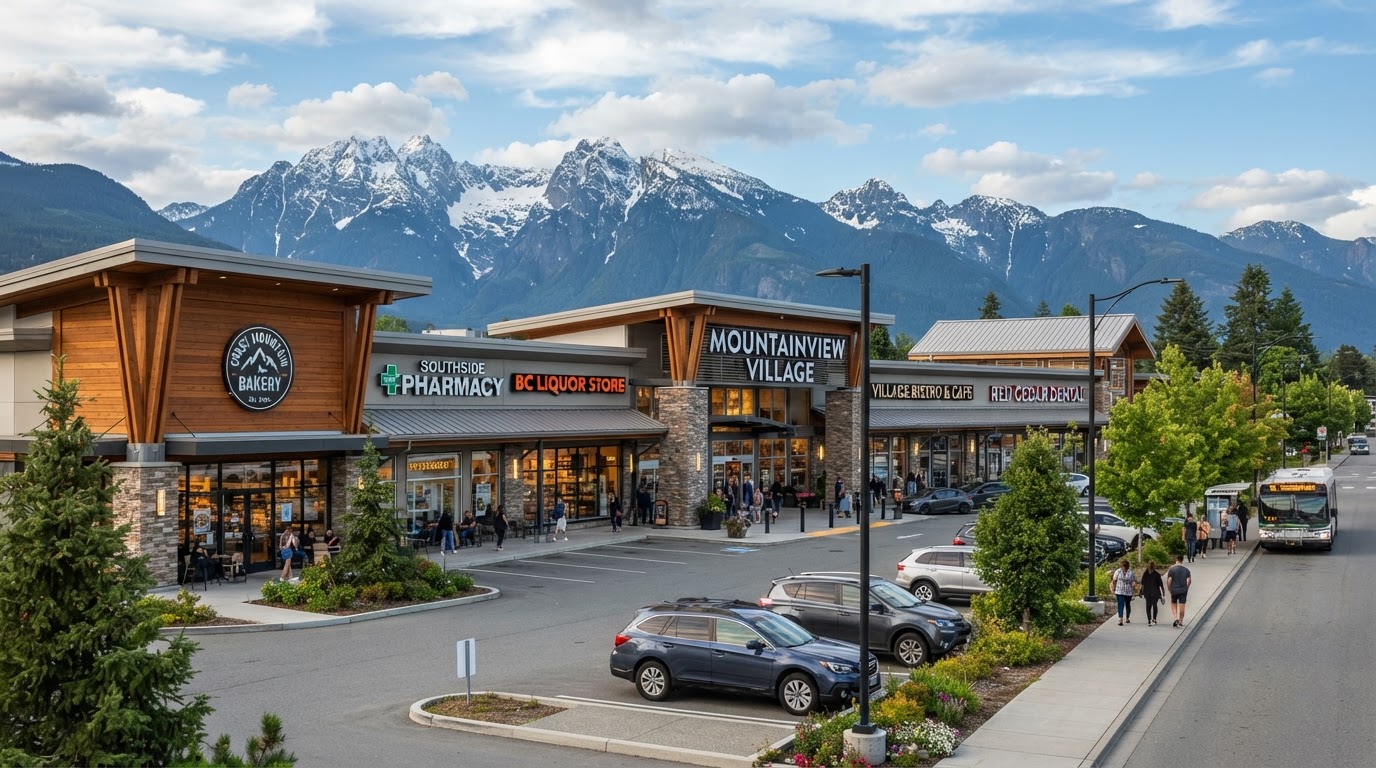
In BC commercial real estate, a strip mall or retail plaza is a small-format commercial building with multiple retail or service tenants, typically arranged in a row with storefronts facing a shared parking area. They range from 2–3 unit neighbourhood plazas to 10+ unit community retail centres.
Key characteristics:
- Size: Typically 3,000–30,000 sq ft of leasable area.
- Tenants: Mix of service businesses (dental, accounting, beauty), food & beverage (restaurants, cafes), convenience retail (grocery, pharmacy), and professional offices.
- Lease structure: Tenants may be on gross, net, or triple-net (NNN) leases, with the landlord responsible for varying levels of building maintenance, property tax, and insurance.
- Parking: Surface parking is typically shared and sized to municipal requirements based on leasable area and tenant type.
Strip malls differ from enclosed shopping centres in their lower operating cost, simpler management, and direct exterior storefront access.
BC Retail Real Estate Market Overview
Several trends are shaping the BC retail plaza and strip mall market:
- Population growth: BC's suburban communities — Surrey, Langley, Abbotsford, Kelowna, Nanaimo — are among Canada's fastest-growing, creating demand for neighbourhood retail.
- Service economy demand: While e-commerce has disrupted traditional retail, service businesses (health, beauty, fitness, food) require physical locations and drive demand for retail plaza space.
- Cap rate stability: Neighbourhood retail in BC has shown stable or compressing cap rates, reflecting investor demand for reliable cash flow.
- Mixed-use redevelopment: Older strip malls on well-located corridors are being redeveloped into mixed-use residential + commercial properties, creating value-add opportunities.
- Essential tenant demand: Grocery-anchored and pharmacy-anchored plazas have proven resilient through economic cycles, with tenants that draw consistent foot traffic.
- New construction scarcity: Limited new retail construction in mature BC communities has stabilized vacancy and supported rent growth for well-located existing plazas.
Top Regions for Strip Malls & Retail Plazas for Sale in BC
1. Metro Vancouver & the Fraser Valley — Surrey, Langley, Abbotsford
The Lower Mainland's growing suburban population and high commercial land values make it BC's strongest retail plaza market. Surrey — BC's fastest-growing city — has new residential developments creating demand for neighbourhood retail. Langley and Abbotsford offer lower acquisition costs than Vancouver while benefiting from the same population growth. Retail plazas on major arterials (King George Boulevard, Fraser Highway, South Fraser Way) with strong traffic counts and grocery anchors are particularly stable.
Buyer profile: Income investors seeking stable multi-tenant cash flow in growing suburban markets.
2. The Okanagan — Kelowna, Vernon, Penticton
The Okanagan's combination of population growth, tourism, and retirement migration creates year-round demand for retail plaza space. Kelowna's expanding commercial corridors (Harvey Avenue, Highway 97) support both community plazas and destination retail. Smaller Okanagan communities offer lower entry costs while benefiting from the region's steady in-migration.
Buyer profile: Lifestyle investors, retirement-destination buyers, and value-add investors targeting plaza renovation or tenant remix.
3. Vancouver Island — Nanaimo, Courtenay, Victoria
Vancouver Island's growing communities and steady in-migration support retail plaza demand. Nanaimo — the Island's commercial hub for the central and north Island — offers cap rates that are typically higher than Victoria while benefiting from similar demographic trends. Victoria offers lower cap rates and higher pricing but very stable tenant demand.
Buyer profile: Investors seeking higher cap rates than Victoria, retirement-destination buyers, and portfolio investors.
4. BC Interior — Kamloops, Prince George, Vernon
The BC Interior offers some of the province's most accessible retail plaza pricing. Kamloops and Prince George serve large regional populations — Prince George is the commercial hub for Northern BC — and retail plazas anchored by grocery, pharmacy, or hardware perform well. These markets offer higher cap rates than the Lower Mainland, making them attractive for investors prioritizing yield.
Buyer profile: Yield-focused investors, value investors, and buyers seeking higher cap rates.
Types of Retail Plazas for Sale in BC
| Type | Typical Size | Best For |
|---|---|---|
| Neighbourhood strip mall | 3,000–10,000 sq ft, 3–6 units | First-time commercial investors, stable local cash flow |
| Grocery-anchored plaza | 10,000–40,000 sq ft | Income investors seeking stable traffic and long-term tenants |
| Service-oriented plaza | 3,000–15,000 sq ft | Investors targeting medical, beauty, fitness, professional tenants |
| Single-tenant retail pad | 1,500–5,000 sq ft | NNN lease investors, restaurant or bank pad buyers |
| Community retail centre | 30,000–100,000 sq ft | Experienced investors, multi-tenant portfolio growth |
| Redevelopment candidate | Varies, older | Value-add / mixed-use developers |
How to Buy a Strip Mall or Retail Plaza in BC: Step-by-Step
- Define your investment criteria: Determine budget, preferred plaza type (neighbourhood, grocery-anchored, service, pad), lease structure (gross, net, NNN), and target region.
- Engage a commercial broker experienced in retail real estate: Retail plaza transactions require analysis of leases, tenant credit, lease expiry rollover, and cap rate. Work with a broker who understands BC commercial investment real estate.
- Analyze the financials: Request rent roll, trailing operating statements, and T-12 cash flow. Key metrics include NOI, cap rate, price per sq ft, occupancy, lease expiry schedule, and tenant CAM (common area maintenance) recovery.
- Review the leases: Every tenant lease must be reviewed for rent, escalation terms, renewal options, NNN obligations, exclusivity clauses, and co-tenancy provisions. The leases determine the property's income stability.
- Assess the physical property: Commission a building inspection, roof assessment, and parking lot condition review. Understand deferred maintenance and upcoming capital expenditures.
- Evaluate the location: Review traffic counts, demographics, household income, and competition within the trade area. Location drives tenant demand and rent levels.
- Conduct due diligence: Review title, environmental status (especially if a gas station or dry cleaner was ever on-site), zoning for retail use, and any pending assessments or notices.
- Secure financing: Retail investment financing is commercial. Conventional lenders may require 30–40% down, 2–3 years of operating statements, and an appraisal. NNN-leased properties with credit tenants may qualify for lower down payments.
- Negotiate and close: Engage a BC commercial real estate lawyer to manage the purchase agreement, assignment of leases, and closing.
Due Diligence Checklist: Retail Plazas for Sale in BC
| Item | Why It Matters |
|---|---|
| Rent roll & lease abstracts | Documents every tenant's rent, term, expiry, and NNN obligations |
| Trailing operating statements (T-12) | Establishes NOI, expenses, and actual cash flow |
| Lease expiry schedule | Identifies rollover risk and re-leasing exposure |
| Tenant credit & sales reports | Assesses tenant viability and rent-to-revenue ratios |
| Building & roof inspection | Identifies deferred maintenance and capital expenditure |
| Parking lot & pavement assessment | Parking lot replacement is a significant capital cost |
| Zoning & permitted use confirmation | Confirms retail use, density, and any redevelopment potential |
| Environmental site assessment (Phase I) | Required if a gas station, dry cleaner, or auto shop was ever on-site |
| Property tax assessment & reassessment | BC assesses property tax on acquisition — confirm post-sale tax |
| CAM reconciliation | Confirms common area maintenance recovery and any shortfalls |
| Title & encumbrances search | Identifies easements, rights-of-way, and any restrictions |
| Demographic & traffic study | Correlates with tenant demand and rent sustainability |
Understanding Cap Rates & Retail Investment Metrics
The capitalization rate (cap rate) is the primary metric for valuing retail income properties. It is calculated as NOI ÷ purchase price. A lower cap rate indicates a higher price relative to income; a higher cap rate indicates a lower price or higher perceived risk.
| Property Profile | Typical BC Cap Rate |
|---|---|
| NNN-leased, national credit tenant | 4.5%–5.5% |
| Grocery-anchored plaza, Metro Vancouver | 4.75%–5.75% |
| Multi-tenant strip mall, Surrey / Langley | 5.0%–6.5% |
| Service-oriented plaza, BC Interior | 6.5%–8.0% |
| Value-add / vacant plaza | 7.5%+ (unstabilized) |
These ranges are illustrative only and vary by property, tenant, lease structure, and market conditions. Verify current cap rates with a commercial broker or appraiser familiar with the specific market.
Lease Structures: Gross, Net & Triple-Net (NNN)
The lease structure determines how operating expenses are allocated between landlord and tenant — and directly affects your net operating income.
| Lease Type | Landlord Pays | Tenant Pays |
|---|---|---|
| Gross lease | All operating expenses | Base rent only |
| Net lease | Structure, some maintenance | Property tax, insurance, some maintenance |
| Triple-net (NNN) | Structure shell | Property tax, insurance, CAM, maintenance |
| Modified gross | Structure & base maintenance | Increases in operating expenses over base year |
For investors seeking predictable cash flow, NNN leases with credit tenants are the most desirable — the tenant pays most operating expenses, and the landlord's income is relatively stable.
Financing a Retail Plaza Purchase in BC
Retail investment financing is commercial and is based on the property's NOI, lease quality, and the buyer's financial profile. Common approaches include:
- Conventional commercial financing: 30–40% down for multi-tenant retail; 2–3 years of operating statements; debt coverage ratio of 1.25+.
- Single-tenant NNN financing: NNN-leased properties with national credit tenants (banks, pharmacies, quick-service restaurants) may qualify for lower down payments and longer amortization.
- Vendor take-back / seller financing: Common in retail transactions; bridges any valuation gap and reduces buyer cash required.
- CMHC-insured loans: Available for qualifying multi-unit residential properties, less common for pure retail.
Speak with a commercial mortgage broker experienced in BC retail investment properties. This section is informational only and not financial advice.
BC-Specific Regulatory Considerations for Retail Buyers
- Zoning: Confirm the property is zoned for retail use and that any planned tenant changes (e.g., adding a restaurant, drive-through, or liquor licence) are permitted.
- Property tax reassessment: BC reassesses property tax on acquisition based on the purchase price. Factor this into your NOI calculation.
- Liquor licensing: If a tenant operates or plans to operate a licensed establishment, confirm the licence status with the BC Liquor and Cannabis Regulation Branch.
- Environmental: Properties that previously housed gas stations, dry cleaners, or auto repair shops may require a Phase I environmental site assessment.
- Real Estate Services Act compliance: Commercial transactions must comply with BC real estate licensing and disclosure requirements.
- Commercial tenancy: BC commercial tenancy is governed by the Commercial Tenancy Act. Review any applicable legislation with a BC commercial lawyer.
Frequently Asked Questions: Strip Malls & Retail Plazas for Sale in BC
How much does a strip mall cost in British Columbia?
Retail plaza prices in BC range widely. A small 3-unit neighbourhood strip mall in the BC Interior may sell for $1–2 million. A 5–8 unit plaza in Surrey or Langley typically sells for $3–8 million depending on NOI, tenant quality, and land value. Grocery-anchored plazas or NNN-leased properties with national credit tenants can sell for $5–20 million+. Verify current pricing by comparing recent sales in your target market.
What is a good cap rate for a retail plaza in BC?
Cap rates vary by property type, tenant quality, and location. In, NNN-leased properties with national credit tenants in Metro Vancouver may trade at 4.5%–5.5%. Multi-tenant strip malls in Surrey or Langley may trade at 5.0%–6.5%. BC Interior plazas may offer 6.5%–8.0%. These are illustrative ranges only — verify current cap rates with a commercial broker or appraiser. This is not financial advice.
What is a triple-net (NNN) lease, and why does it matter?
In a NNN lease, the tenant pays base rent plus property tax, insurance, and common area maintenance (CAM). This shifts most operating expense risk to the tenant and provides the landlord with predictable income. NNN leases with credit tenants (national chains, banks, pharmacies) are the most desirable for investors seeking stable cash flow.
Can I redevelop a strip mall into mixed-use in BC?
In many BC communities, yes — older strip malls on well-located corridors are being redeveloped into mixed-use residential + commercial properties, particularly in Metro Vancouver and the Okanagan. Redevelopment feasibility depends on zoning, density, height limits, parking, and municipal policy. Confirm redevelopment potential with the local municipality and a qualified planner or architect before purchasing.
What financing is available for a retail plaza purchase in BC?
Conventional commercial financing (30–40% down), NNN financing for credit-tenant properties (potentially lower down), vendor take-back mortgages, and portfolio loans from credit unions are all options. Lenders evaluate the property's NOI, lease quality, and the buyer's financial profile. Speak with a commercial mortgage broker experienced in BC retail investment.
What due diligence should I do before buying a retail plaza in BC?
Request a rent roll, lease abstracts, trailing operating statements, building and roof inspection, parking lot assessment, environmental assessment (if applicable), zoning confirmation, property tax reassessment estimate, and a title search. Engage a BC commercial real estate lawyer to manage the transaction and lease assignments.
What is the difference between buying a strip mall and buying a single-tenant retail pad?
A strip mall has multiple tenants, diversifying income but requiring active management. A single-tenant pad (e.g., a restaurant or bank pad on a NNN lease) offers simpler management and stable income from one tenant, but concentrates risk in a single lease. The right choice depends on your management capacity and risk preference.
Ready to Find a Strip Mall or Retail Plaza for Sale in BC?
Whether you are seeking a grocery-anchored plaza in Surrey, a neighbourhood strip mall in the Okanagan, a NNN-leased single-tenant pad, or a redevelopment candidate in Metro Vancouver, Rexara Realty Inc. can help you identify and acquire the right retail investment for your portfolio.
We work with investors across British Columbia's retail real estate market — providing access to on-market and off-market opportunities, lease and financial analysis support, and end-to-end transaction advisory.
Gurjit Ghai
REALTOR® — Personal Real Estate Corporation
Rexara Realty Inc.
☎ 778-855-2019
✉ info@rexararealty.com
🌐 www.rexararealty.com
This article is for educational purposes only and does not constitute legal, financial, investment, or real estate advice. Market data is drawn from publicly available sources and changes over time. Verify current figures with the original sources and consult qualified professionals before making real estate or financial decisions.

Gurjit Ghai, REALTOR®
Gurjit Ghai Personal Real Estate Corporation
Brokerage: Rexara Realty Inc.
Licensed Managing Broker specializing in commercial transactions, residential acquisitions, ALR farmland, and business brokerage across British Columbia.
Verify licence on BCFSA public registry →View author profile & articles →⚖️Important Real Estate & Legal Disclaimer
This article is provided for general informational and educational purposes only and does not constitute legal, tax, accounting, financial, or professional real estate advice. Real estate laws, BC Financial Services Authority (BCFSA) guidelines, municipal bylaws, and tax regulations (including Property Transfer Tax, GST, and cooling-off rules) are subject to change and apply differently based on individual circumstances.
Readers should not act or rely upon any information contained herein without obtaining competent professional legal, tax, or financial counsel and consulting directly with a licensed British Columbia real estate professional. Rexara Realty Inc., its managing broker, and its associated licensees expressly disclaim all liability with respect to actions taken or not taken based on any content in this article.